Швидка відповідь
Автентичність зображення поєднує виявлення ШІ, аналіз маніпуляцій, контекстуальний огляд і сигнали походження, щоб оцінити, чи можна довіряти фотографії.
 PhotoProof Labs
A fast verification workflow for social-media images that may be AI-generated, edited, old, or posted with false context.
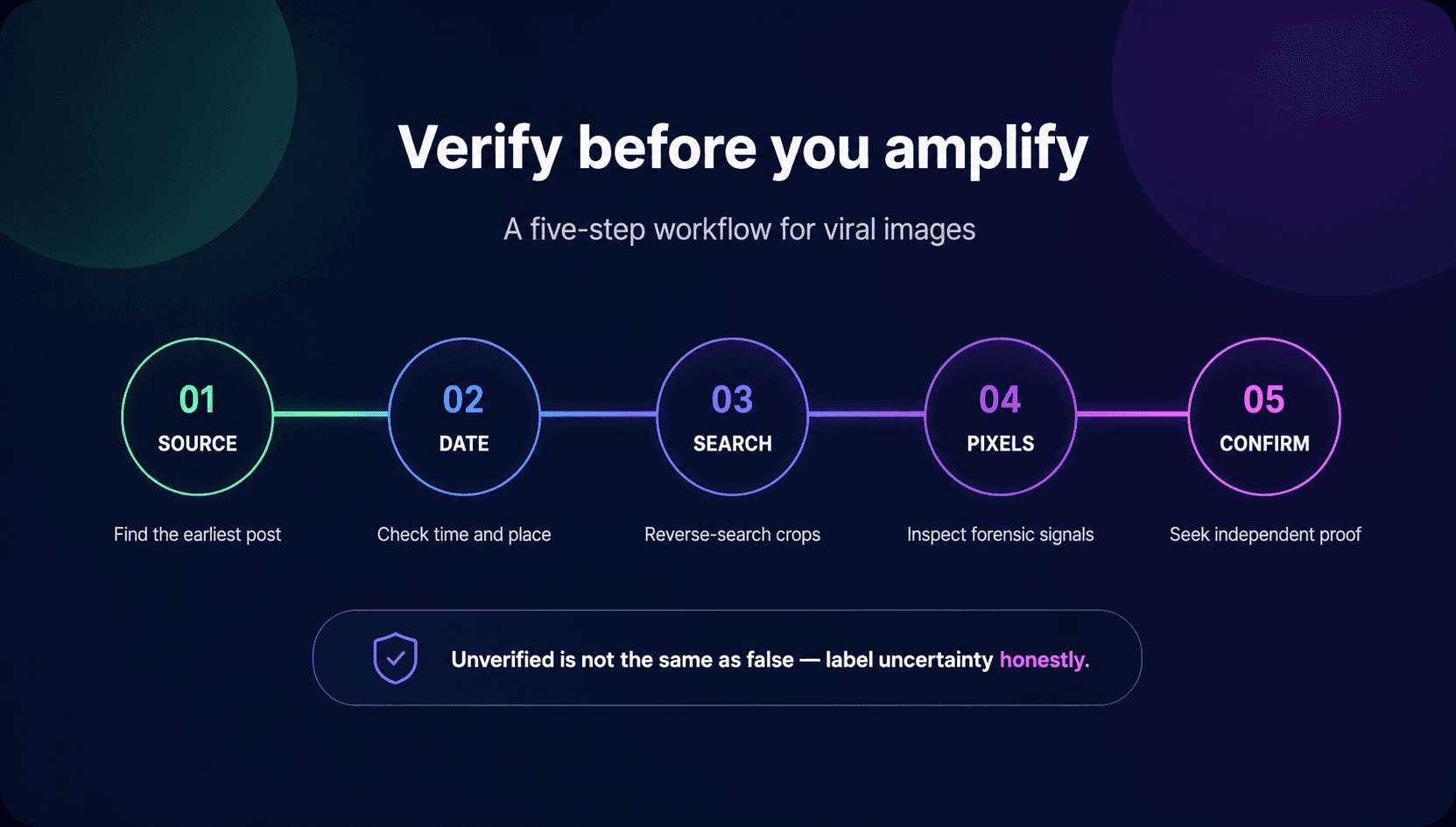
Pause before sharing, locate the earliest source, verify the claimed date and location, reverse-search the image, inspect it for generation or manipulation clues, and look for independent confirmation from reliable sources.
Write down what the post claims happened, where, and when. This prevents a striking image from making the caption feel true by association.
Follow reposts backward, search quoted caption phrases, and inspect replies for attribution. The earliest source may reveal that the image is satire, artwork, an older event, or generated content.
Compare weather, signage, language, landmarks, shadows, clothing, and seasonal details with the claimed place and time.
Use reverse search, metadata when available, and multi-signal forensic analysis. Look for synthetic text, repeated crowd faces, inconsistent reflections, compositing edges, and impossible scene geometry.
For significant events, look for multiple independent photographs, local reporting, official notices, or eyewitness material from different angles. One unexplained image is not enough.
Yes. Real images are frequently reused with the wrong date, place, or event description.
A label is useful context, but labeling systems can be incomplete or mistaken. Review the source and evidence.
Do not present it as confirmed. Share the uncertainty explicitly or avoid amplifying it.
Автентичність зображення поєднує виявлення ШІ, аналіз маніпуляцій, контекстуальний огляд і сигнали походження, щоб оцінити, чи можна довіряти фотографії.
Автентичність зображення поєднує виявлення ШІ, аналіз маніпуляцій, контекстуальний огляд і сигнали походження, щоб оцінити, чи можна довіряти фотографії.
Image Authenticity: Cluster for verifying whether a photo is authentic, manipulated, AI-generated, or misleading.
Ці посилання добираються автоматично — за темою та зв'язками між сторінками, а не вручну.
Перейдіть до наступного посібника в цьому тематичному кластері.
Ознайомтеся зі сторінками методології та досліджень.
Уточніть терміни, що використовуються в цій темі.
Порівняйте суміжні робочі процеси виявлення та перевірки достовірності.
Ознайомтеся з обсягом тестування та доказами, що стоять за заявами про продуктивність виявлення.
Продовжте з найкориснішим наступним поняттям.